

The Math of Backcountry Survival: R-Values, Fuel Rates, and Altitude Limits
Standard outdoor blogs publish generic packing lists and surface-level gear roundups. However, real field preparation relies on applied thermodynamics and precise mathematical constraints.
Whether calculating heat loss to frozen soil or predicting canister fuel consumption at high elevations, field math provides exact answers to critical gear questions. Here is how to run the numbers before heading into the backcountry, along with the right gear from Occasionally Outdoors to execute your plan safely.
1. Sleeping Pad Math: R-Value Stacking
Your sleeping bag traps warm air around your body, but ground contact compresses its down or synthetic insulation. Conductive heat loss occurs directly through the bottom of your pad.
Under the ASTM F3340-18 testing standard, R-value measures thermal resistance. Unlike temperature ratings, R-values are strictly additive:
R_total = R1 + R2 + … + Rn
| Target Ground Temp | Required Min. R-Value | Typical Field Configuration |
| > 10°C (50°F) | R 1.0 – 2.0 | Summer air pad |
| -1°C (30°F) | R 3.0 – 4.0 | 3-Season insulated air pad |
| -12°C (10°F) | R 5.0 – 5.5 | 3-Season air pad (R = 3.5) + Closed-Cell Foam pad (R = 2.0) |
| -20°C (-4°F) | R 6.5+ | Insulated winter air pad (R = 4.5) + High-density CCF pad (R = 2.0) |
The Stacking Rule
Place a high-density Closed-Cell Foam (CCF) pad directly on the tent floor, underneath your inflatable air pad.
- Puncture Defense: Protects your lightweight inflatable air pad from sharp ground debris, rocks, and pine needles.
- Convective Dampening: Blocks cold ground temperatures from chilling the air inside your inflatable pad’s internal chambers.
Recommended Setup from Occasionally Outdoors:
Pair our Inflatable Camping Sleeping Pad Waterproof Blue with a high-density foam accordion pad to double your ground insulation barrier without adding excessive weight. Complete your winter sleep system with our Goose Down Sleeping Bag – Black for maximum thermal retention.
Backcountry R-Value Stacking Calculator
Calculate Your Setup
Common Stacked Combinations
| Configuration | Total R | Min Temp |
|---|---|---|
| Uninsulated Air Pad (1.5) | 1.5 | > 10°C (50°F) |
| 3-Season Air Pad (3.5) | 3.5 | -1°C (30°F) |
| Air Pad (3.5) + CCF Pad (2.0) | 5.5 | -12°C (10°F) |
| Winter Air Pad (4.5) + CCF (2.0) | 6.5 | -20°C (-4°F) |
2. Canister Fuel Consumption & Burn Mechanics
A standard 100g isobutane/propane fuel canister contains exactly 100 grams of usable fuel net weight (gross weight is roughly 100g fuel + ~100g steel canister = ~200g total weight).
The Baseline Formula
Total Fuel (g) = (Liters to Boil x Fuel Rate per Liter) + Safety Margin
- Ideal Conditions (20°C, sea level, zero wind): Integrated stove systems use approximately 10g to 12g of fuel per 1L boil. Standard open-burner portable stoves use 15g to 18g.
- Real-World Baseline: Budget 15g per 1L of boiled water for basic freeze-dried meals, morning coffee, and camp prep.
High Altitude & Cold Adjustments
- Atmospheric Pressure: Water's boiling point drops at higher elevations (~93°C at 2,100 m / 7,000 ft). While water boils faster at lower temperatures, cooking raw food or rehydrating meals takes longer, consuming more total fuel.
- Vapor Pressure Drops: Below 0°C (32°F), the internal pressure inside an isobutane canister drops sharply, slowing fuel delivery to the burner.
Adjusted Fuel Needed = Baseline Fuel x Altitude Multiplier x Wind Multiplier
- Low Temp / High Altitude (> 2,500 m): Multiply fuel estimate by 1.25.
- Moderate Wind (10 – 20 km/h without windscreen): Multiply fuel estimate by 1.35 to 1.50.
- Melting Snow for Water: Requires double the fuel (~30g to 35g per liter of liquid water produced).
Recommended Setup from Occasionally Outdoors:
Pair our lightweight Camping Cookware Kit with Stove Green or Cookware Set Ultralight, Aluminum And Nonstick with a compact aluminum windscreen. Efficient cookware heat transfer prevents wind shear from doubling your fuel burn rate.
3. Frequently Asked Questions
How do you calculate sleeping pad R-value when stacking two pads?
To calculate stacked sleeping pad R-values, simply add the R-values of both pads together (R_total = R1 + R2). For example, placing a closed-cell foam pad (R = 2.0) underneath an inflatable air pad like our Inflatable Camping Sleeping Pad Waterproof Blue (R = 3.5) yields a total thermal insulation rating of R = 5.5, which is suitable for cold winter camping down to -12°C (10°F).
How much canister stove fuel do I need per day for backcountry camping?
A standard open-burner canister stove uses roughly 15 grams of isobutane fuel per 1 liter of water boiled under normal conditions. For basic meal prep and hot drinks using compact cookware like our Cookware Set Ultralight, Aluminum And Nonstick, budget 30 grams of fuel per person per day. Add a 25% safety buffer for high winds, cold temperatures, or elevations above 2,500 meters.
Does cold weather lower canister stove fuel efficiency?
Yes, ambient temperatures below 0°C (32°F) drop the internal vapor pressure of isobutane/propane fuel canisters, significantly reducing burner output and efficiency. To prevent performance loss, keep canisters inside your jacket before use, submerge the base in a shallow dish of cool water while boiling, or use a liquid-feed inverted canister stove setup.
Why should a closed-cell foam pad be placed under an inflatable sleeping pad?
Placing a closed-cell foam pad underneath an inflatable pad offers two main benefits: physical protection against sharp rocks or pine needles that could puncture the air bladder, and convective dampening that stops cold ground temperatures from chilling the air sealed inside the inflatable pad.
4. Backcountry Execution Checklist
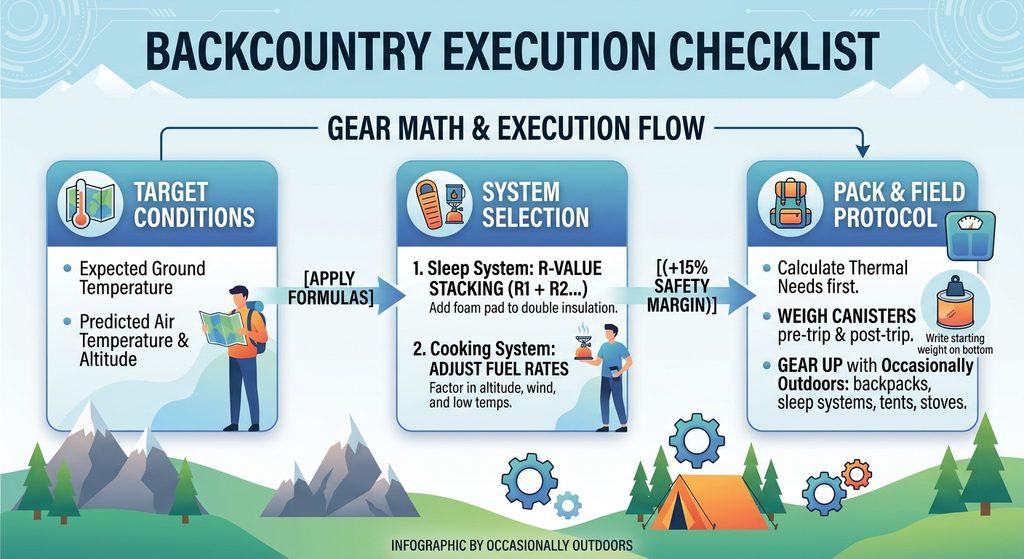
- Calculate exact thermal needs before buying new sleep systems. Adding an inexpensive closed-cell foam pad underneath your current pad instantly doubles your ground insulation.
- Weigh fuel canisters on a digital scale before and after every trip. Write the gross starting weight on the bottom of the steel canister with a permanent marker so you can track remaining fuel grams in the field.
- Gear up with Occasionally Outdoors. Pack your gear in our 1.2kg Lightweight 90L Expedition Backpack or 56L Hiking & Trekking Backpack and browse our full collection at occasionallyoutdoors.ca to get field-ready for your next adventure.
