

7 Best Backpacking Games for Kids: Lightweight & No-Gear Outdoor Fun
When backpacking with kids, every ounce matters. Gear, food, and safety essentials quickly fill pack volume, leaving no room for bulky board games, heavy toys, or decks of cards that can easily get lost or ruined by wet weather.
Keeping young hikers motivated on the trail and entertained around camp doesn’t require adding extra weight to your pack. The wilderness itself provides an endless arena for interactive, creative, and educational games.
To help make your next family trip seamless, we’ve created pocket-sized field guides you can print before hitting the trail. You can browse our full collection of gear checklists, field sheets, and outdoor guides in the Occasionally Outdoors Resource Hub.
Here are 7 zero-weight, leave-no-trace backcountry games designed to keep kids engaged, build outdoor confidence, and turn long miles into high-energy family adventures.
Trail Games: Keeping Feet Moving & Minds Engaged
1. Trail Bingo (Nature Detective Edition)
When miles start feeling long, turning the trail into a real-time observation game keeps young eyes sharp and minds focused off tired feet.
- How to Play: Before hitting the trail, establish a mental list of 5 to 10 specific nature markers to spot during the trek. Keep the items diverse:
- A tree bent like an elbow
- A piece of birch bark peeling naturally
- Animal tracks in dirt or mud
- Glacial erratics (out-of-place boulders)
- A bird of prey soaring overhead
- Shelf fungus on a fallen log
- The Twist: The first person to spot an item calls out “Bingo!” and explains what they found. To encourage teamwork rather than racing ahead, make it a cooperative goal where the family works together to complete the entire list before reaching the next rest stop or campsite.
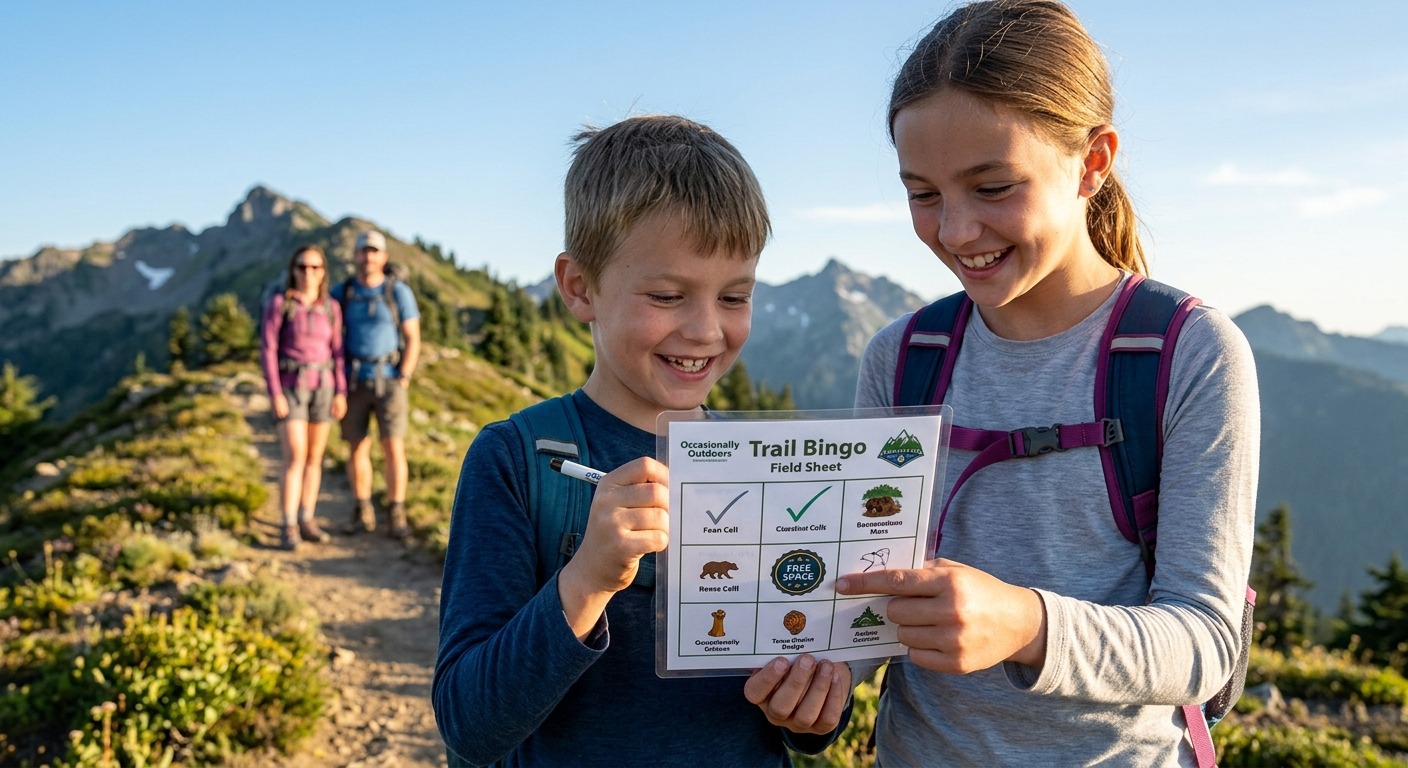
Free Printable Download: Save ink and paper on your trek with our Trail Bingo Field Sheet PDF—a compact, Leave-No-Trace checklist designed to slide right into a hip-belt pocket. Discover more trail activities in the Occasionally Outdoors Resource Hub.
2. The 20 Questions Wilderness Challenge
A classic guessing game with an ecological spin that reinforces plant, animal, and landscape identification skills.
- How to Play: One hiker thinks of an outdoor-related secret item. It must be something visible or commonly found in the immediate environment or ecosystem you are hiking through (e.g., Douglas fir, grizzly bear, campfire smoke, granite cliff).
- The Rules: The rest of the group takes turns asking yes-or-no questions to narrow down the answer (e.g., “Is it alive?”, “Does it live in the water?”, “Is it smaller than a pinecone?”). The group gets up to 20 total questions to guess the item correctly.
3. Story Stacking
Story Stacking is ideal for steady uphill climbs or flat stretches when hiking rhythm sets in. It builds creative storytelling and keeps group morale high.
- How to Play: The lead hiker begins a story with a single opening sentence set in the backcountry (e.g., “As we crossed the wooden footbridge, a mysterious whisper came from inside the hollow oak tree…”).
- The Rules: The next hiker in line adds exactly one sentence to continue the plot, followed by the next person. The story rotates through the line continuously. Encourage kids to introduce unexpected plot twists, wilderness survival challenges, or friendly woodland characters.
Camp Games: Unwinding Around the Campsite
4. “I Spy” Camouflage Hunt
Once the tent is pitched and gear is stowed, kids can test their observation and camouflage skills right around the perimeter of camp.
- How to Play: One child (the “Camper”) steps away from camp for 30 seconds while the remaining players choose a natural object within view—a specific pinecone, an uniquely shaped stone, or a clump of lichen on a rock.
- The Rules: Without moving or picking up the item, players sit naturally near or around it. The Camper returns and tries to guess which specific object the group selected, using only visual clues and spatial awareness. This game reinforces the principle of looking closely at natural textures without disturbing wildlife or moving natural features.
5. Soundscape Mapping (1-Minute Quiet Game)
Backcountry travel can sometimes feel fast-paced. Soundscape mapping teaches mindfulness, sensory awareness, and active listening in nature while providing a moment of calm rest.
- How to Play: Everyone finds a comfortable spot to sit or recline near camp, closes their eyes, and holds up two closed fists.
- The Rules: Set a timer for 60 seconds of complete silence. Every time a hiker hears a distinct wilderness sound (e.g., wind rustling pine needles, a distant creek, a woodpecker tapping, a chipmunk chatter), they raise one finger. When time is up, compare notes on how many unique sounds were identified and where they came from.
6. The Paracord & Knot Challenge
While paracord is a practical gear essential for hanging bear bags or setting up tarps, a spare 3-foot length of cordage makes a versatile interactive learning tool.
- How to Play: Use short lengths of utility cord or extra guyline to host mini knot-tying speed challenges or teaching sessions.
- Knots to Master:
- The Square Knot: Great for joining lines of equal thickness.
- The Bowline: The essential loop knot every young camper should know.
- The Taut-Line Hitch: Useful for tensioning tent guylines.
- The Challenge: Once learned, test skill and memory with fun constraints: tying a square knot behind your back, or seeing who can tie a secure bowline in under 10 seconds.
Free Printable Download: Download our Essential Knot-Tying Pocket Guide PDF featuring step-by-step memory rhymes for the Square Knot, Bowline, and Taut-Line Hitch. Access more wilderness skill guides in the Occasionally Outdoors Resource Hub.
7. Sinking Ship & Backcountry Charades
As evening sets in and night falls around the campsite, silent charades bring plenty of laughter without disturbing neighboring campsites or backcountry wildlife.
- How to Play: Players act out common, funny, or challenging backcountry scenarios without speaking or making sound effects while others guess the action.
- Scenario Ideas:
- Trying to put on a rain jacket in a sudden downpour
- Encountering a swarm of blackflies
- Slipping on a muddy river crossing
- Pitching a dome tent in high winds
- Trying to crawl out of a tight sleeping bag in the cold morning
Tips for Success on Family Backcountry Trips
- Keep Safety First: Establish clear campsite boundary rules before playing games around camp. Ensure kids understand never to wander out of sight or earshot.
- Embrace Leave No Trace: Remind young explorers that natural items—like wildflowers, colorful stones, and fallen branches—belong to the ecosystem and should be left where they lie after games are finished.
- Follow Energy Levels: Match games to the team’s energy. Use rhythmic vocal games like Story Stacking during long trail miles to maintain momentum, and switch to calm, seated games like Soundscape Mapping when kids need rest.
Looking for more field sheets, gear packing checklists, and backcountry meal planning guides? Explore our full collection of printable resources in the Occasionally Outdoors Resource Hub.
