

How to Calculate Sleeping Pad R-Value for Cold-Ground Canadian Camping
During Canadian shoulder seasons (April–May and September–November), ambient air temperatures can be deceiving. A sunny 10 degrees Celsius afternoon in Algonquin Park or the Rockies can drop to a crisp 0 degrees Celsius at night.
However, the real heat thief isn’t the cold air—it’s the ground beneath your tent.
Due to thermal mass, soil retains winter freeze deep into spring and cools down long before air temperatures drop in late autumn. If you rely solely on ambient air temperature ratings when choosing your sleeping pad, conductive heat loss will drain your body heat all night, regardless of how warm your sleeping bag is.
The Cold Ground Trap: ASTM F3340-18 vs. Canadian Soil Physics
Modern sleeping pad warmth is measured using the standardized ASTM F3340-18 test protocol. This test measures thermal resistance (R-value) by placing an inflated pad between two plates: a warm plate on top (35 degrees Celsius) simulating human body heat, and a cold plate underneath (5 degrees Celsius) simulating frozen ground.
While ASTM F3340-18 provides a fair rating system across outdoor brands, it assumes a fixed ground baseline of 5 degrees Celsius.
In Canadian spring and autumn conditions, real-world variables break this laboratory baseline:
- Frost Depth & Thermal Inertia: Ground temperature lags behind air temperature by several weeks. In early spring, ground temperatures frequently remain between -2 degrees Celsius and 2 degrees Celsius even when air temperatures sit around 10 degrees Celsius.
- Moisture & Saturated Soil: Damp spring soil conducts heat away from your body up to 20 times faster than dry summer soil.
- Draft Convection: Uninsulated air chambers in lightweight summer pads allow internal air to circulate, continually transferring your body heat directly into the frozen earth.
Canadian Shoulder-Season R-Value Adjustment Formula
To calculate the true required R-value for Canadian shoulder season camping, apply the Thermal Lag Adjustment Formula:
Target R-Value = R-Air + R-Ground Factor + R-Sleeper Modifier
Step 1: Base Ambient Air R-Value (R-Air)
Match your expected overnight low air temperature to standard baseline requirements:
| Night Low Air Temp | Base R-Value Requirement (R-Air) |
| 10 degrees Celsius and above | 1.5 – 2.0 |
| 2 degrees Celsius to 9 degrees Celsius | 2.0 – 3.2 |
| -5 degrees Celsius to 1 degree Celsius | 3.5 – 4.5 |
| Below -5 degrees Celsius | 5.0+ |
Step 2: Add Ground & Environmental Factors (R-Ground Factor)
Adjust your base R-value depending on ground moisture and surface composition:
- Saturated / Muddy Spring Soil: Add +0.8
- Frozen / Frost-Covered Earth: Add +1.0
- Granite Canadian Shield Bedrock: Add +0.5 (Rock acts as a massive thermal sink)
- Dry Leaf Litter or Pine Needles: Add 0.0 (Natural insulative ground cover)
Step 3: Add Personal Sleeping Preference (R-Sleeper Modifier)
- Cold Sleeper: Add +0.5
- Warm Sleeper: Subtract -0.2
Example Calculation:
Camping in Algonquin in mid-May with an expected air low of 2 degrees Celsius (R-Air = 3.0), pitching on damp, cold spring soil (R-Ground Factor = +0.8), for a cold sleeper (R-Sleeper Modifier = +0.5):
Target R-Value = 3.0 + 0.8 + 0.5 = 4.3
Result: A standard 3-season pad (R-value 3.0) will leave you cold. You require a pad setup rated at R-4.3 or higher.
How to Stack Pads for Modular R-Value Warmth
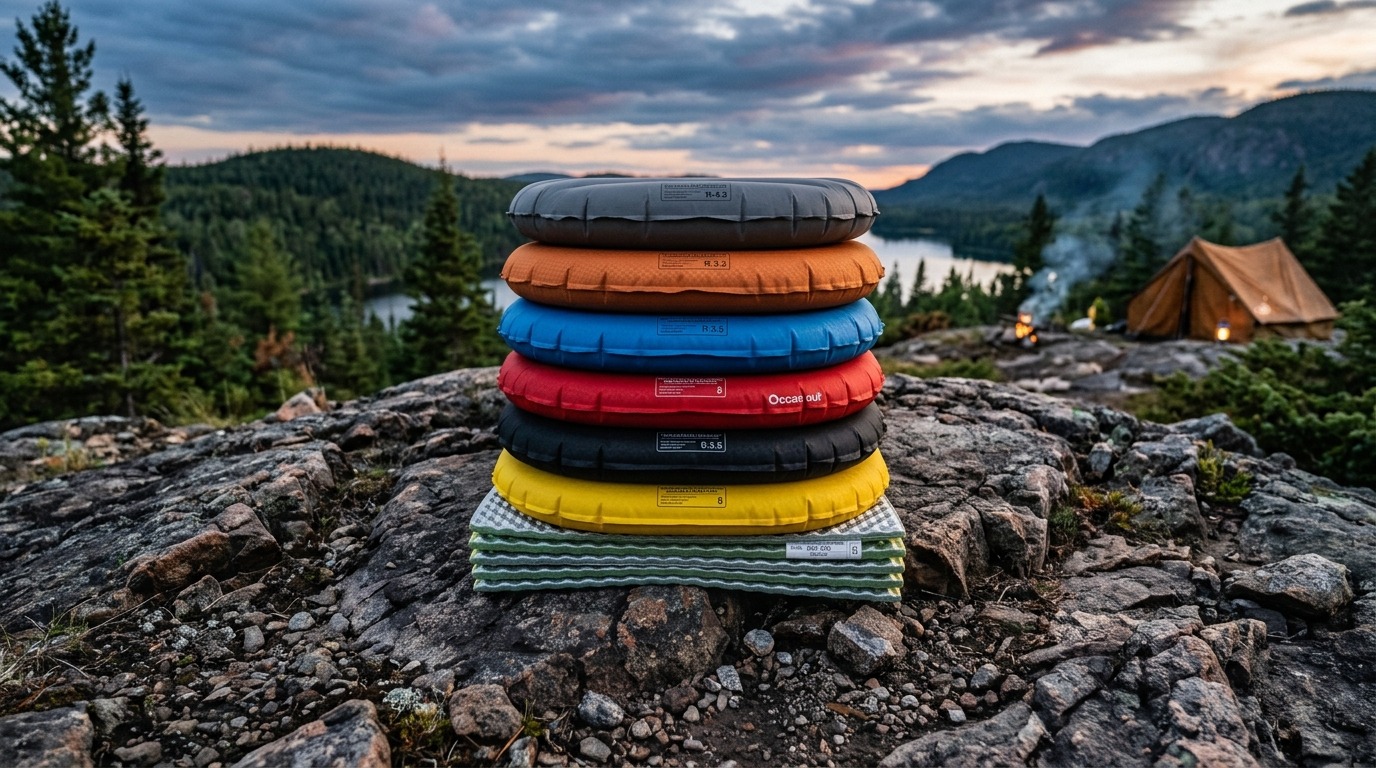
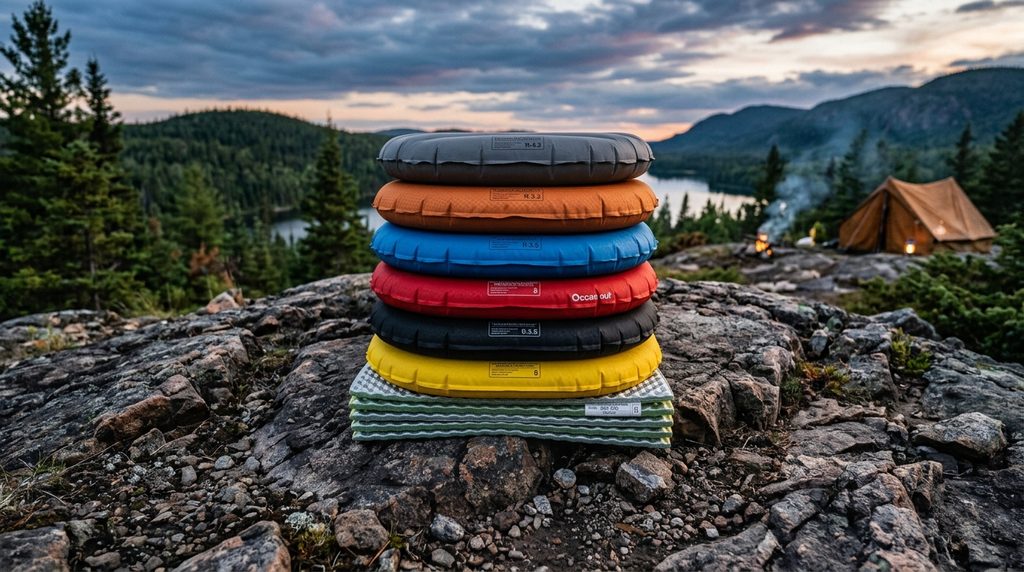
You do not need to buy a heavy winter sleeping pad for spring and fall trips. R-value is additive. By combining a closed-cell foam (CCF) pad underneath an inflatable air pad, you add thermal resistance while protecting your inflatable pad from sharp Canadian Shield terrain.
🌲 Shoulder-Season Sleep System Essentials
When camping in cold-ground Canadian environments, pairing the right insulation with proper shelter setup is critical:
- 🏕️ Insulated Sleep Systems: Explore our tested Insulated Sleeping Pads & Camp Mattresses.
- ⛺ Weather-Proof Shelters: Pair your sleep setup with durable 3-Season & Ultralight Backpacking Tents.
- 🍳 Warm Trail Meals: Hot food speeds up metabolic warmth before bed. Check out our backcountry-approved Camp Stoves & Kitchen Accessories.
❓ Frequently Asked Questions
What R-value is needed for spring and fall camping in Canada?
For spring and autumn camping in Canadian national and provincial parks, aim for a minimum R-value of 3.5 to 4.5. Saturated ground in spring and early frosts in fall drain body heat through conduction much faster than ambient summer soil.
Does a sleeping bag increase R-value?
No. Your sleeping bag’s down or synthetic fill gets compressed under your body weight, eliminating the dead air spaces needed for insulation. Your sleeping pad—not your sleeping bag—provides virtually all conductive heat protection from the ground.
Can you stack two sleeping pads to increase R-value?
Yes, R-values are directly additive. Laying a closed-cell foam pad (R-2.0) beneath an inflatable air mattress (R-3.0) gives you a combined R-value of 5.0, making it suitable for sub-zero degrees Celsius ground temperatures.
