Can You Use a Camp Stove During a Fire Ban in Canada? (2026 Park Guide)
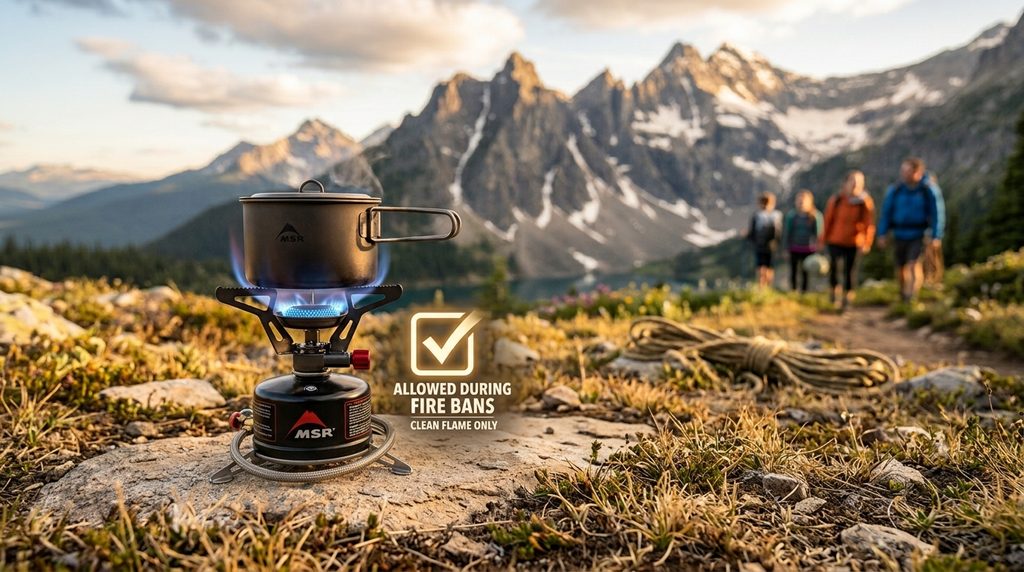
When a total fire ban (Level 2 Restricted Fire Zone) is declared across Canadian provincial or national parks, campfires, charcoal briquettes, and wood-burning stoves are immediately prohibited. However, that doesn’t mean you’re stuck eating cold meal bars for your entire trip.
Understanding which stoves are permitted during fire bans—and how to operate them safely—ensures you stay warm, fed, and compliant with local conservation laws.
Quick Reference: Stove Types Allowed vs. Banned
Stove / Appliance Type
Allowed During Fire Ban?
Key Requirements & Restrictions
Canister Stoves (Isobutane / Propane)
YES
Must have an integrated fuel shut-off valve/control knob.
Liquid Fuel Stoves (White Gas / Naptha)
YES
Must have a manual control valve. Exercise extreme caution during priming.
Propane Camp Stoves (2-Burner Coleman type)
YES
Must be positioned on non-combustible surfaces; keep shut-off valve accessible.
Alcohol / Spirit Burners (Trangia, Brass)
NO(In most jurisdictions)
Lacks an instant shut-off valve; liquid spill hazards are high.
Uses wood/biomass fuel and produces floating embers and ash.
Charcoal Briquettes / Dutch Ovens
NO
Retains residual heat and produces wind-blown embers.
Detailed Breakdown by Stove Type
1. Gas Canister & Propane Stoves (PERMITTED)
Pressurized gas stoves that run on isobutane/propane mix or 1lb propane cylinders are universally permitted during fire bans across Parks Canada, Ontario Parks, BC Parks, and SEPAQ.
The Rule: The unit must feature a dedicated control valve or shut-off knob that instantly extinguishes the flame when turned off.
Safety Tip: Place your stove on a flat, non-combustible surface (like a rock, metal camp table, or cleared mineral soil) away from dry needle cast or forest duff.
2. Liquid Fuel Stoves (PERMITTED WITH CAUTION)
Stoves running on liquid naphtha/white gas (such as the MSR WhisperLite or Dragonfly) are legally permitted because they feature a fuel control valve.
The Rule: The stove must have a shut-off valve.
Safety Tip: Priming liquid fuel stoves generates a temporary flare-up. Prime your stove well clear of dry vegetation, tents, and wooden picnic tables to prevent accidental ground ignition.
Compact wilderness stoves that burn twigs, pinecones, or wood pellets (e.g., Solo Stove Lite, Kelly Kettle, or homemade alcohol-can stoves) fall under the exact same prohibition as open campfires.
Why They Are Banned: Even though they are enclosed, wood-burning stoves emit flying sparks, ash, and embers that can easily drift into surrounding dry brush.
4. Charcoal, Briquettes & Cast Iron Coals (STRICTLY PROHIBITED)
Cooking with charcoal briquettes or placing hot coals on top of a Dutch oven is completely forbidden during fire bans.
Why They Are Banned: Charcoal retains intense heat long after cooking ends and generates ash embers that can be picked up by wind gusts.
Provincial Differences You Should Know
While the core rule requiring an instant shut-off valve applies across Canada, regional park authorities enforce minor differences:
Ontario Parks (MNRF Restricted Fire Zones): Portable gas or liquid fuel stoves are allowed for cooking and warming, provided they are placed at least 1 meter away from flammable materials.
Parks Canada (National Parks): Self-contained liquid or gas-fueled appliances are permitted. They must be designed specifically for cooking or heating and used inside designated camping areas.
BC Parks: Requires flame height to be under 15 cm and requires portable stoves to be CSA or ULC rated.
Frequently Asked Questions
Can I use a portable propane fire pit during a fire ban?
In many provincial parks (such as BC Parks and select Ontario Parks), CSA-approved portable propane fire pits with an instant shut-off valve are permitted, provided the flame height remains under 15 cm. However, during extreme wildfire hazards, park superintendents may issue total bans that include propane fire pits. Always check local park alerts before lighting one.
What happens if I violate a fire ban in a park?
Violating a Restricted Fire Zone in Canada carries severe legal penalties. Fines under provincial forest fire acts range from $300 to over $25,000, and campers can be held financially liable for the costs of extinguishing any forest fire caused by an illegal flame.
Looking for a fire-ban-compliant camp kitchen setup? Shop our collection of Isobutane Canister Stoves.
Occasionally Outdoors
As the founder and creative voice behind Occasionally Outdoors, they are a dedicated wilderness enthusiast, outdoor gear tester, and digital content builder based in Ontario, Canada. With years of hands-on experience navigating backcountry trails, family car camping trips, and wilderness cooking techniques—from cast iron Dutch oven recipes to ultralight stove operations—they focus on making outdoor recreation accessible, safe, and enjoyable for everyone.
When not testing equipment on the trail or writing comprehensive backcountry safety guides, they curate high-performance outdoor gear and apparel for outdoor adventurers across Canada.
Cookie Consent
We use cookies to improve your experience on our site. By using our site, you consent to cookies.
Contains information related to marketing campaigns of the user. These are shared with Google AdWords / Google Ads when the Google Ads and Google Analytics accounts are linked together.
90 days
__utma
ID used to identify users and sessions
2 years after last activity
__utmt
Used to monitor number of Google Analytics server requests
10 minutes
__utmb
Used to distinguish new sessions and visits. This cookie is set when the GA.js javascript library is loaded and there is no existing __utmb cookie. The cookie is updated every time data is sent to the Google Analytics server.
30 minutes after last activity
__utmc
Used only with old Urchin versions of Google Analytics and not with GA.js. Was used to distinguish between new sessions and visits at the end of a session.
End of session (browser)
__utmz
Contains information about the traffic source or campaign that directed user to the website. The cookie is set when the GA.js javascript is loaded and updated when data is sent to the Google Anaytics server
6 months after last activity
__utmv
Contains custom information set by the web developer via the _setCustomVar method in Google Analytics. This cookie is updated every time new data is sent to the Google Analytics server.
2 years after last activity
__utmx
Used to determine whether a user is included in an A / B or Multivariate test.
18 months
_ga
ID used to identify users
2 years
_gali
Used by Google Analytics to determine which links on a page are being clicked
30 seconds
_ga_
ID used to identify users
2 years
_gid
ID used to identify users for 24 hours after last activity
24 hours
_gat
Used to monitor number of Google Analytics server requests when using Google Tag Manager
1 minute
SourceBuster is used by WooCommerce for order attribution based on user source.
Name
Description
Duration
sbjs_session
The number of page views in this session and the current page path
30 minutes
sbjs_udata
Information about the visitor’s user agent, such as IP, the browser, and the device type
session
sbjs_first
Traffic origin information for the visitor’s first visit to your store (only applicable if the visitor returns before the session expires)
session
sbjs_current
Traffic origin information for the visitor’s current visit to your store
session
sbjs_first_add
Timestamp, referring URL, and entry page for your visitor’s first visit to your store (only applicable if the visitor returns before the session expires)
session
sbjs_current_add
Timestamp, referring URL, and entry page for your visitor’s current visit to your store
session
sbjs_migrations
Technical data to help with migrations between different versions of the tracking feature